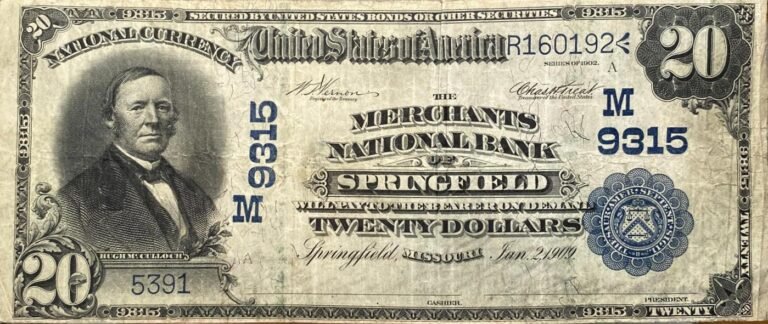
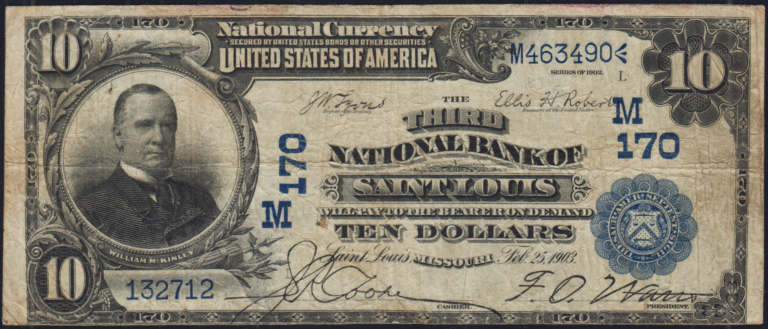
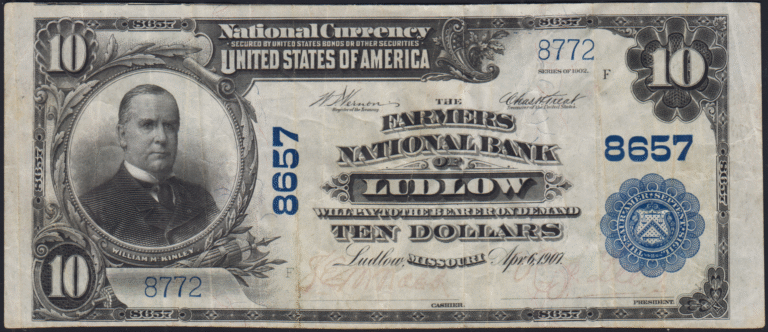
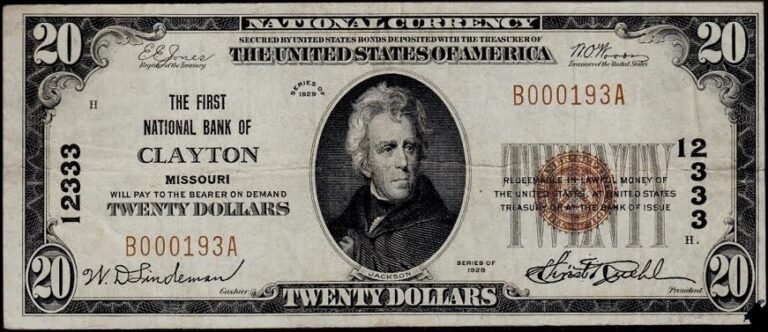
Missouri’s national banknote history reflects the state’s pivotal role in American expansion and commerce. As a gateway between East and West, Missouri’s banks helped finance river trade, railroads, and frontier settlement. From the bustling streets of St. Louis and Kansas City to the quiet towns of Hannibal and Boonville, Missouri’s national banknotes tell a story of ambition, resilience, and regional pride.
Between 1863 and 1935, 265 national banks across Missouri issued currency, making the state a significant contributor to the National Bank Note Era. Early institutions like the First National Bank of Kansas City (Charter #3456) and the Central National Bank of Boonville (Charter #1584) helped establish financial stability in the post-Civil War years. Banks in towns such as Maryville, Sedalia, and Grant City issued notes that circulated through general stores, stockyards, and steamboat depots—each bearing the signatures of local bankers and the identity of their communities.
Missouri national banknotes offer a vivid portrait of the state’s economic evolution. A $10 Series 1902 Date Back from the Hannibal National Bank (Charter #—), signed by J.P. Hinton and S.M. Carter, captures the elegance and utility of early 20th-century currency. Notes from banks in Cape Girardeau, Tarkio, and Sedalia reflect the diversity of Missouri’s industries—from river trade and agriculture to education and manufacturing. These notes are prized not only for their scarcity but for the stories they preserve.
Today, Missouri national banknotes are cherished artifacts of frontier finance and civic identity. Whether issued in the shadow of St. Louis’s arch or the quiet streets of a rural county seat, each note is a tangible link to the people and places that shaped the Show-Me State. In the broader narrative of American currency, Missouri’s contribution stands as a testament to the grit and growth of the Midwest.
Our team of experts will look over your note and answer any questions you may have.